Somebody Has to Build the Cars
The fear about AI and jobs is aimed correctly and timed wrong.
I got fired for using too much AI. Then I got hired to lead with it. Same skill, same person, roughly a year apart. The market changed its mind about what I was doing faster than I changed what I was doing.
That experience is why I have limited patience for the current panic, and why I take the panic seriously anyway. Both of those things are true at once, and most of the arguments I read online manage only one of them.
The fear goes like this. AI eats the work. The work does not come back. Humans get sorted into a small class who own the machines and a large class who have nothing to sell. I hear some version of this every week, usually from people who have never watched an agent refactor a nine-crate Rust workspace and have very strong opinions about what agents can do.
The fear is correct about the destination. It is wrong about the next twenty years, and the next twenty years are where everyone actually lives.
The word we keep using wrong
We call these people Luddites. Worth knowing what the Luddites were actually doing, because the record is nothing like the insult.
They were skilled textile workers in Nottinghamshire and Yorkshire around 1811. They understood the machines fine. Many of them had operated machines for years. Their objection was to wage collapse and to mill owners staffing new frames with unskilled labor at a fraction of the rate. They smashed specific frames belonging to specific owners who had cut specific wages. They left other frames alone.
They lost. The frames won. The textile industry got enormous and the wages eventually rose. The Luddites were also right about the fifteen years directly in front of them, which were genuinely brutal for the people living through them.
Keep both halves. The long arc went their opponents’ way. The short arc broke exactly as they predicted. That pattern repeats, and it is the whole story here.
The horse economy died and something bigger showed up
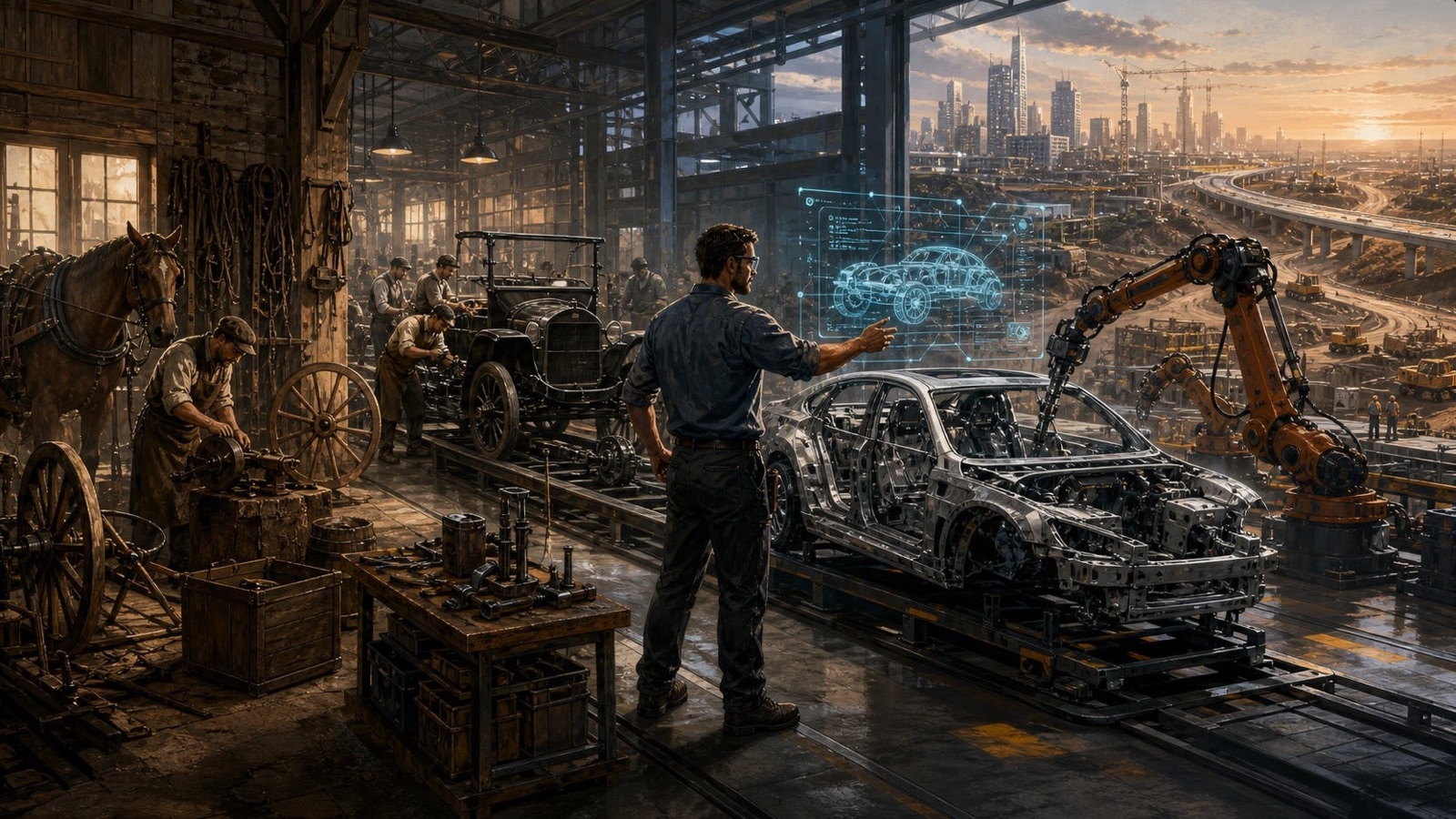
In 1900 the United States ran on horses. Farriers, harness makers, wheelwrights, stable hands, teamsters, feed merchants, the crews who shoveled manure out of Manhattan by the ton every single day. It was an entire economy with its own supply chain, its own apprenticeships, its own trade press.
The automobile ended it fast.
What replaced it dwarfed it. Assembly line work, dealerships, parts manufacturing, the oil and refining industry at continental scale, road construction, traffic engineering, driver licensing, auto insurance, body shops, the motel, the roadside diner, the drive-through, the suburb, the trucking industry, the entire logistics profession. Millions of jobs where thousands had been.
Here is the part that matters for us. Almost none of those jobs were imaginable from inside the harness shop. A wheelwright in 1900 could not have described a traffic engineer, because traffic did not exist yet as a thing that required engineering. The replacement work was invisible from the vantage point of the work being destroyed.
That is a permanent feature. You cannot see the next industry from inside the one that is dying. Your imagination is furnished entirely with the current furniture.
The counterargument that actually lands
Wassily Leontief won a Nobel Prize in economics and in the early 1980s he made the sharpest version of the case against everything I just wrote.
The horses did not get the automobile jobs.
That is the argument. Horses were a labor input. The technology replaced the input. The US horse population peaked around twenty six million and fell to roughly three million by 1960, and it never recovered, because there was no retraining program for a horse. If human labor is the input this time rather than the operator, we get the horse outcome. Bigger industry, fewer humans in it.
I think Leontief is right about the end state and wrong about the sequence. Every transition so far has created a new operator layer above the automated one, and the operator layer has been larger than the layer it replaced.
I am standing in one. My job is agentic engineering. I direct systems that write the code I used to write by hand, and I spend my time on architecture, adversarial review, and the judgment calls that decide whether shipped software is any good. That role did not exist in 2023. I have written about what survives when the machine does the eighty percent that looked like the job, and the short version is that the protected work is judgment, taste, and accountability. Those are operator functions. They are hiring.
The B Ark problem
The Golgafrinchans solved their unemployment question by deciding which third of the population was useless. Telephone sanitizers, hairdressers, marketing executives. They loaded that third onto the B Ark, told them the planet was doomed, and fired them into space.
The remaining two thirds were subsequently wiped out by a disease contracted from an unsanitized telephone.
I bring this up every time someone confidently lists which jobs are about to become worthless. We are historically terrible at identifying which work is load-bearing. The categories that look most obviously automatable have a habit of turning out to hold the system up. Douglas Adams got there before the economists did.
The clock is running faster
Horse to automobile took about forty years. The web took ten. Mobile took five.
This one will be shorter than mobile, and that compression is the legitimate grievance inside the panic. A forty year transition means one generation retires out of the old work and the next generation trains into the new. A five year transition means the same person absorbs the whole thing mid career, twice, possibly three times.
The aggregate story stays cheerful. Bigger industry, more jobs, higher wages, and the aggregate story is cold comfort to a forty-five year old whose expertise expired on a Tuesday. That is the Luddite short arc, and dismissing it as technophobia is how you lose the argument to people who are describing their actual lives.
I have argued that the discipline outlives the tasks, and I stand by it. The discipline surviving does very little for you during the eighteen months you spend rebuilding what you know.
Where this ends
Run the sequence forward far enough and the pattern breaks. Each cycle produces a new operator layer, and each cycle the machines climb into more of it. There is a point where automating the operator layer leaves nothing above it, and Leontief’s horses stop being a bad analogy and start being a description.
That is a real destination and we are pointed at it. What it looks like when human labor becomes optional, what an economy denominated in compute instead of wages does to all of this, and whether any of our current institutions survive contact with it, is a separate post and a longer argument.
For now we are in the automobile phase. The horse economy is going away and something considerably larger is under construction. Somebody has to build the cars.
Learn to direct the machines. Do it this year.
First published August 26, 2026 on 42 Insights.
Get new posts by email
One email when something new goes up. Nothing else, ever.
You will get a confirmation email first, and every post has an unsubscribe link. Prefer a reader? Use the RSS feed.