The Great Shift
How AI Infrastructure Will Replace Traditional Software Architecture
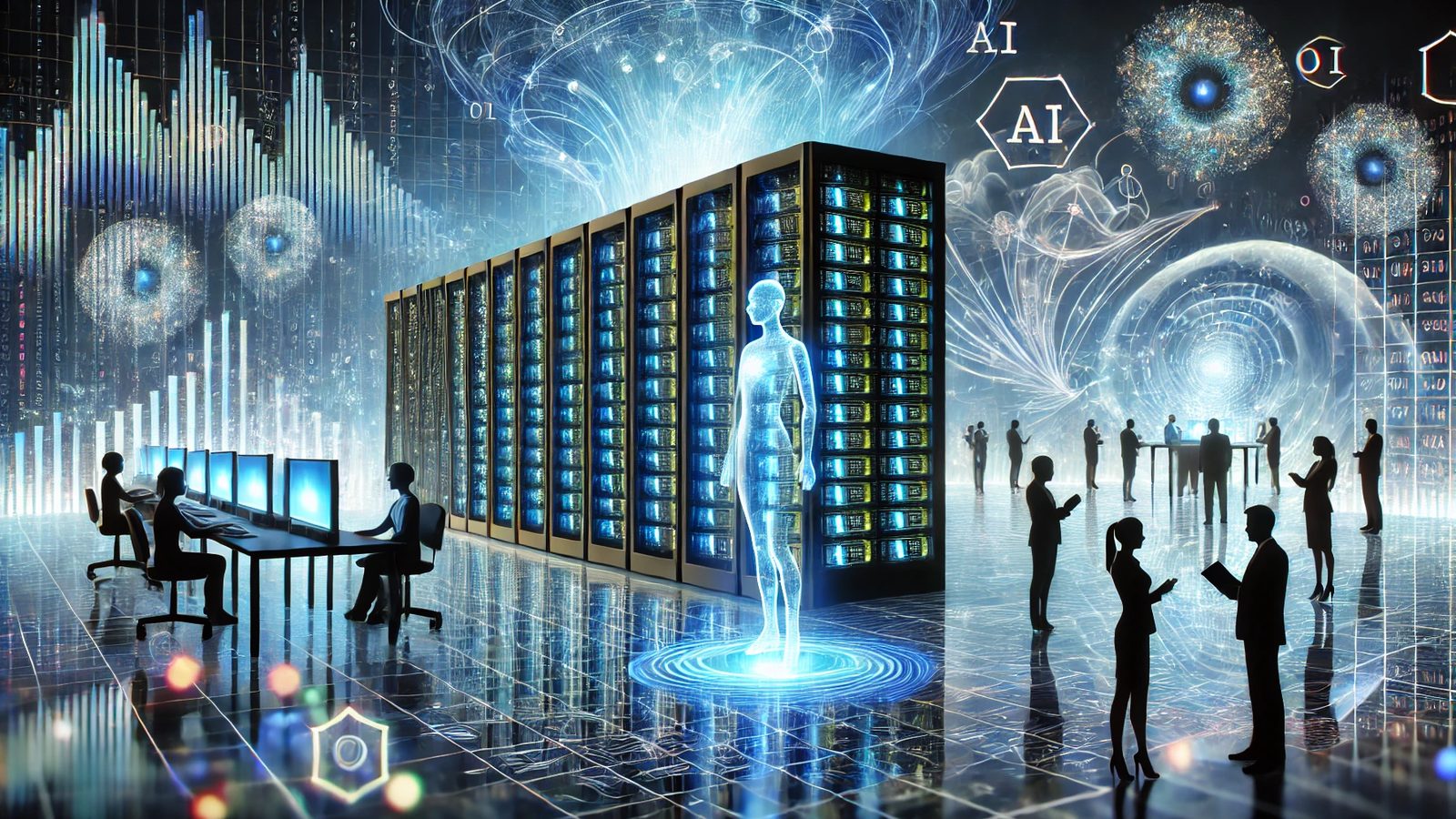
As NVIDIA's recent GTC announcements have made clear, we're standing at the precipice of a fundamental transformation in how we conceptualize computing infrastructure. While much attention has focused on AI augmenting traditional software development, I believe something far more revolutionary is occurring: the eventual obsolescence of purpose-built software applications as we know them.
From Purpose-Built to General Intelligence
For decades, our computing paradigm has been built around specialized software designed for specific functions. Need to manage an automotive dealership? There's a dedicated DMS platform for that. Need accounting capabilities? Install QuickBooks or SAP. Want to store files? Deploy a file server with a purpose-built file system.
This approach made sense in a world of limited computing capabilities and narrow algorithmic scope. But what NVIDIA's latest announcements suggest—with their focus on massive AI acceleration, interconnect technologies, and large-scale training infrastructure—is that we're rapidly moving toward a fundamentally different architecture.
The Emerging AI Infrastructure Landscape
Instead of servers dedicated to vertical applications, we'll increasingly see computing resources allocated to general-purpose AI agents that can adapt to any task at hand. These won't be pre-programmed with domain-specific knowledge about automotive sales cycles or accounting principles—they'll learn these domains through interaction, training data, and feedback loops.
Consider what this means for traditional IT architecture:
- Database servers will transition from structured repositories with predefined schemas to dynamic knowledge stores that AI agents can query, manipulate, and restructure based on emergent needs.
- File storage systems will evolve beyond hierarchical directory structures into semantic content repositories where AI understands what the information means, not just where it's stored.
- Vertical applications like DMS or ERP systems will dissolve into capability spaces where AI agents orchestrate business processes without being explicitly programmed for those domains.
Not the End of Software Development—But Its Transformation
It would be a mistake to frame this as "AI replacing programmers." Rather, software development as we understand it today—writing domain-specific applications for particular business functions—will gradually become obsolete.
Developers won't disappear. Instead, their role will transform into:
- AI Infrastructure Engineers who design and optimize the underlying systems that enable AI agents to operate effectively across domains.
- Prompt Engineers and AI Trainers who help shape the capabilities and behaviors of general-purpose AI systems to address specific business needs.
- AI Safety and Governance Specialists who ensure these systems operate within appropriate ethical and operational boundaries.
The Practical Implications
What might this look like in practice? Imagine a car dealership in this new paradigm:
Instead of purchasing and maintaining a specialized DMS, they would interact with AI agents through natural language and visual interfaces. These agents would understand the dealership's inventory management needs, financial tracking requirements, customer relationship processes, and service department workflows—not because they were programmed specifically for these functions, but because they've learned to understand and execute these business processes through general intelligence capabilities.
When the dealership needs new functionality, there's no software update cycle or custom development. The AI infrastructure adapts to new requirements through conversation, demonstration, and feedback. "We need to start tracking customer satisfaction scores for each service technician" becomes a capability the system can immediately incorporate without traditional coding.
The Technology Foundations Are Already Here
NVIDIA's latest announcements around their Blackwell architecture, massive increases in computational efficiency for AI workloads, and improvements in multi-modal AI capabilities aren't just incremental advances. They represent the necessary infrastructure components for this vision to become reality.
The computational demands of generalized AI systems capable of replacing domain-specific software are enormous—but the trajectory of hardware advancement, particularly with specialized AI accelerators, suggests these requirements will be met sooner than many expect.
The Timeline for Transformation
This transformation won't happen overnight. We're seeing the early stages now with AI assistants handling increasingly complex tasks within traditional software environments. The middle phase—which we're rapidly approaching—will feature hybrid systems where AI agents work alongside purpose-built applications, gradually assuming more functionality.
The final phase, where general AI infrastructure largely replaces traditional software architecture for most business functions, may be a decade away—but the foundations are being laid today with each new advance in AI hardware and foundation models.
Conclusion: Preparing for the New Paradigm
For business leaders and IT professionals, this shift demands forward-thinking strategy. Investments in monolithic, domain-specific applications may increasingly represent technological dead ends. Instead, focus should turn toward:
- Building flexible data architectures that can serve AI-driven operations
- Developing organizational capabilities around AI oversight and guidance
- Creating business processes that can evolve with AI capabilities rather than being tightly coupled to specific software functions
The history of computing has been marked by paradigm shifts—from mainframes to client-server, from on-premises to cloud. The shift from purpose-built software to general AI infrastructure represents the next great transition, one that will fundamentally reshape how we conceptualize, build, and interact with computing systems.
The future of IT isn't about better software—it's about no software. At least, not as we've known it.
First published March 19, 2025 on 42 Insights.
Get new posts by email
One email when something new goes up. Nothing else, ever.
You will get a confirmation email first, and every post has an unsubscribe link. Prefer a reader? Use the RSS feed.