The Babelfish: From Fiction to Reality with AI and Noise-Canceling Headphones
Introduction
Introduction
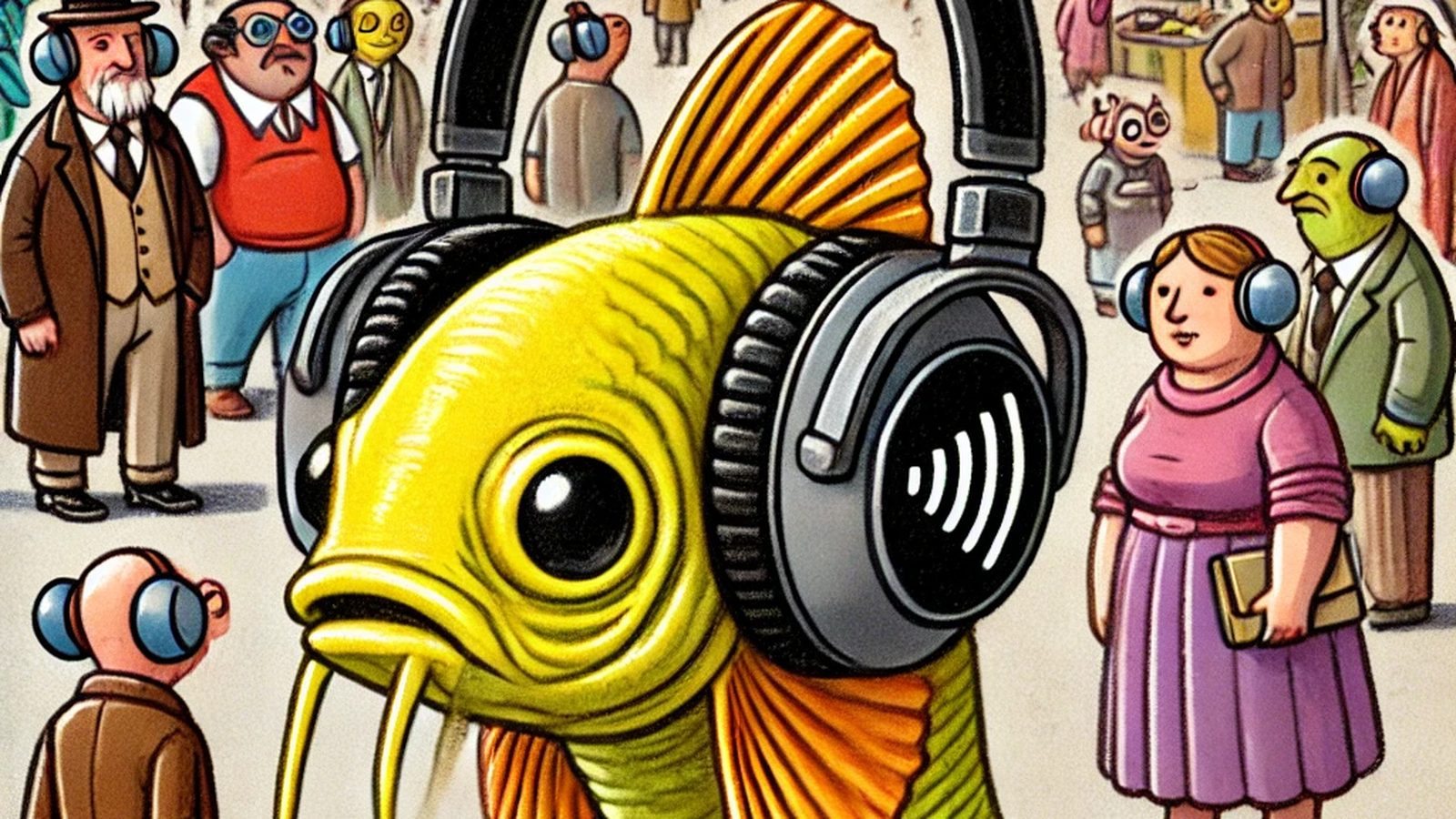
In the vast and often bewildering universe of Douglas Adams' The Hitchhiker's Guide to the Galaxy, the Babelfish stands out as one of the most ingenious inventions. A tiny, yellow, leech-like creature that, when inserted into the ear, instantly translates any spoken language into the wearer's native tongue. This whimsical creation seemed as fantastical as it was improbable. Yet, with the advancements in AI and noise-canceling technology, we are closer than ever to making the Babelfish a reality.
The Babelfish in Hitchhiker's Guide to the Galaxy
The Babelfish is introduced early in The Hitchhiker's Guide to the Galaxy, serving as a comedic yet profound symbol of universal communication. According to the Guide, the Babelfish feeds on brainwave energy, excreting a telepathic matrix that decodes languages directly into the host's brain. This miraculous creature renders intergalactic travel more manageable and highlights Adams' knack for blending humor with insightful commentary on human nature and communication.
The Role of AI in Language Translation
In the real world, AI has made significant strides in breaking down language barriers. Tools like Google Translate and AI-driven language models are constantly improving, enabling real-time translation with increasing accuracy. Neural networks, trained on vast datasets, can now understand context, idioms, and even subtle nuances in language, bringing us closer to the seamless communication envisioned by the Babelfish.
Noise-Canceling Headphones: The Perfect Companion
Enter noise-canceling headphones. These devices, designed to block out unwanted ambient sounds, have evolved beyond their initial purpose. Modern noise-canceling headphones now come equipped with advanced microphones and AI-driven processing capabilities. This combination allows for real-time language translation directly into the user's ears, akin to the Babelfish's instantaneous linguistic understanding.
The Fusion of Technologies: Our Modern Babelfish
Imagine putting on a pair of sleek, noise-canceling headphones equipped with an AI translator. As you walk through a bustling market in a foreign country, you hear a myriad of languages. Yet, through your headphones, everything is translated seamlessly into your native tongue. Conversations become effortless, and the world feels a little bit smaller and more connected.
Challenges and Future Prospects
While the technology is promising, several challenges remain. The accuracy of AI translations still has room for improvement, particularly with less common languages and dialects. Additionally, achieving the instantaneous, fluid translations that the Babelfish offers in The Hitchhiker's Guide to the Galaxy requires overcoming significant technical hurdles. However, with ongoing research and development, these obstacles are gradually being addressed.
Conclusion
Douglas Adams' Babelfish may have started as a whimsical piece of science fiction, but its real-world counterpart is becoming increasingly plausible. Through the fusion of AI and noise-canceling headphones, we are inching closer to a future where language barriers are a thing of the past. So, next time you put on your noise-canceling headphones, remember: you might just be experiencing the early days of your very own Babelfish.
First published August 7, 2024 on 42 Insights.
Get new posts by email
One email when something new goes up. Nothing else, ever.
You will get a confirmation email first, and every post has an unsubscribe link. Prefer a reader? Use the RSS feed.